PPC Management Agency: Your Definitive Guide to Finding the Right Partner & Maximizing ROI
PPC Management Agency: Your Definitive Guide to Finding the Right Partner & Maximizing ROI
Are you pouring money into Google Ads, only to wonder where it’s all going? You’re not alone. The world of Pay-Per-Click (PPC) advertising is a powerful engine for business growth, but it’s also a complex machine with countless moving parts. Mastering it requires more than just a budget; it demands strategy, expertise, and constant optimization. For many businesses, the key to unlocking its true potential isn’t about working harder—it’s about finding the right partner.
This guide is designed to be your definitive resource for understanding, evaluating, and partnering with a PPC management agency. We’ll demystify the entire process, from the fundamentals of what makes a campaign successful to the critical questions you must ask before signing a contract. You’ll learn not just what an agency does, but how a truly great agency thinks, troubleshoots, and transforms your advertising spend into measurable revenue. Forget the jargon and the black box approach; it’s time for clarity and results.
Introduction: Unlocking Growth with Strategic PPC Advertising
1. The Power of Pay-Per-Click in Today’s Digital Marketing Landscape
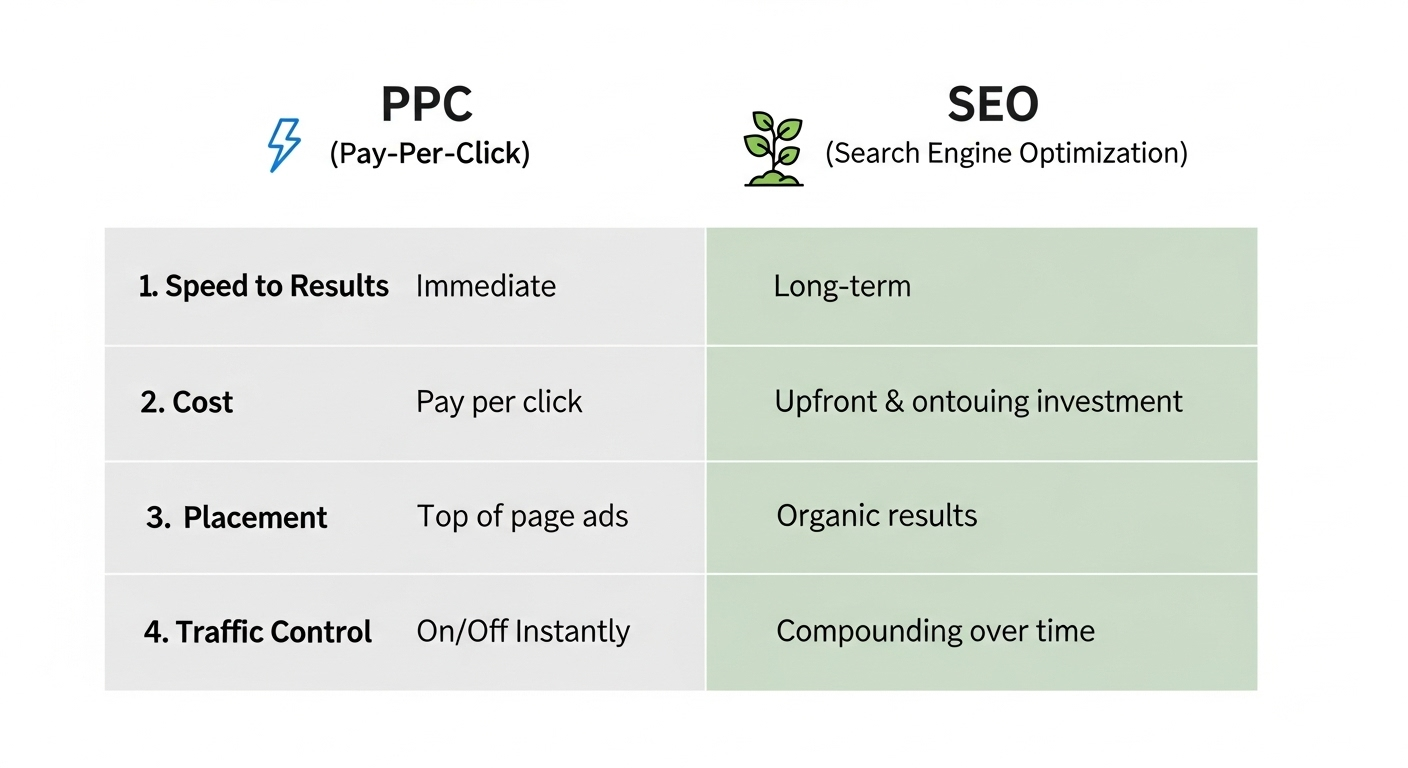 PPC offers immediate visibility, while SEO builds long-term organic authority. Both are crucial, but serve different strategic goals.
In a digital world crowded with noise, PPC advertising cuts through. It places your business directly in front of potential customers at the exact moment they are searching for a solution you provide. Unlike long-term strategies like SEO, PPC offers immediate visibility and traffic, giving you a powerful lever to drive leads and sales on demand. This isn’t just about getting clicks; it’s about connecting with high-intent audiences on major platforms like Google and social media. When executed correctly, your PPC campaigns become a predictable and scalable source of growth, providing a direct line between your marketing investment and your revenue goals.
2. Why a Strategic PPC Management Agency is Your Key to Maximizing ROI
 A great PPC agency manages a complex ecosystem of interconnected tasks to turn your ad spend into measurable ROI.
While the concept of PPC is simple—pay for clicks—the execution is profoundly complex. Effective PPC management is a full-time discipline involving deep keyword research, compelling ad copywriting, intricate bid strategies, audience targeting, landing page optimization, and relentless data analysis. This is where a strategic PPC management agency becomes indispensable.
They aren’t just campaign operators; they are expert navigators of this complex ecosystem. A dedicated agency brings a wealth of cross-industry experience, access to advanced tools, and a team of specialists focused on one thing: turning your ad spend into the highest possible return on investment (ROI). They handle the day-to-day complexities, allowing you to focus on running your business, all while ensuring your marketing budget is working as efficiently as possible to generate tangible results.
Understanding the Fundamentals: What is PPC and Why Does Your Business Need It?
1. What Exactly is Pay-Per-Click (PPC) Advertising?
Pay-Per-Click (PPC) is an online advertising model where advertisers pay a fee each time one of their ads is clicked. Essentially, you’re buying visits to your site rather than trying to “earn” those visits organically through search engine optimization (SEO).
The most common form of PPC is search engine advertising. When someone searches on Google for keywords related to your business, your ad can appear at the top of the results page. This provides an incredible opportunity to capture the attention of motivated buyers. Each click represents a potential customer actively seeking your products or services, making it a highly effective method for driving qualified traffic directly to your website. The core of any PPC campaign is the strategic selection of these keywords, ensuring your ads are shown to the most relevant audience possible.
2. The Undeniable Benefits of PPC for Your Business
Integrating PPC into your marketing strategy offers a host of powerful benefits that directly impact your bottom line. It’s more than just driving traffic; it’s about achieving specific business objectives with speed and precision.
- Immediate and Targeted Traffic: Unlike organic strategies that can take months to yield results, a well-structured PPC campaign can start driving targeted traffic to your website within hours of launch. You have granular control over who sees your ads based on keywords, demographics, location, and even past online behavior.
- Measurable Results and ROI: Every aspect of a PPC campaign is trackable. You can see exactly how many people saw your ad, how many clicks it received, and most importantly, how many of those clicks resulted in a conversion (like a lead, a sale, or a phone call). This data-rich environment allows you to calculate a precise ROI and make informed decisions about your marketing costs and budget allocation. In fact, PPC traffic often outperforms other channels, with some data suggesting that PPC traffic converts 50% better than organic traffic.
- Control and Flexibility: PPC advertising gives you complete control. You set the daily budget, you decide how much you’re willing to pay per click, and you can turn campaigns on or off with a mouse click. This flexibility is invaluable for testing new offers, responding to market changes, or scaling up quickly during peak seasons.
- Synergy with Other Marketing Channels: The insights gained from your PPC campaigns are a goldmine of data. The keywords that generate the most conversions can inform your SEO and content marketing strategy. The audience data can refine your social media targeting. PPC doesn’t operate in a silo; it enhances and accelerates your entire marketing ecosystem.
3. Key Components of a High-Performing PPC Campaign
A successful PPC campaign is not a single entity but a carefully assembled machine of interconnected parts. Each component must be optimized to work in harmony with the others to achieve maximum efficiency and revenue.
- Strategic Keyword Research: This is the foundation. It involves identifying the high-intent keywords your potential customers are using on a search engine and filtering out irrelevant terms that waste money.
- Compelling Ad Copy: Your ad is your digital storefront sign. It needs to grab attention, communicate your unique value proposition, and persuade the user to click. It must be relevant to the keyword and the user’s search query.
- Targeted Ad Groups: Instead of lumping all your keywords into one massive group, you organize them into tight, thematic ad groups. This allows you to write highly specific ad copy that matches the keywords, which improves relevance and Quality Score.
- Optimized Landing Pages: The click is just the beginning. The user must land on a website page that is a seamless continuation of the ad’s promise. A high-converting landing page is relevant, user-friendly, and has a clear call-to-action to guide the user toward a conversion.
- Smart Bidding and Budgeting: This involves setting bids strategically to get the most valuable clicks for your budget. While the average CPC for Google Ads is $2.69, this varies wildly by industry. Effective management means knowing when to bid up on high-performing keywords and how to allocate your budget across different campaigns for the best overall return.
4. Diverse PPC Advertising Formats and Platforms
While Google Search is the titan of PPC, the landscape is vast and diverse. A comprehensive PPC strategy often involves a multi-platform approach to reach customers at different stages of their buying journey.
- Google Ads (Search): The most well-known platform, placing text ads on Google search results pages. It’s ideal for capturing high-intent users actively looking for solutions. With Google projected to capture about 50.5% of all search ad spending in the U.S., its dominance is undeniable.
- Display Advertising: These are visual ads (banners, images, videos) that appear on websites, apps, and platforms across the Google Display Network. They are excellent for building brand awareness and remarketing to users who have previously visited your website.
- Social Media Advertising: Platforms like Facebook, Instagram, LinkedIn, and X (formerly Twitter) offer powerful PPC options. Their strength lies in deep demographic, interest, and behavioral targeting, allowing you to reach very specific audience segments.
- Shopping Ads (eCommerce): For retail businesses, Google Shopping ads are essential. These product-focused ads appear at the top of search results with an image, price, and store name, providing a highly visual and compelling format for online shoppers.
- Video Advertising: Platforms like YouTube allow you to run video ads before, during, or after other video content. This is a powerful medium for storytelling, product demonstrations, and building a deeper connection with your audience.
The Indispensable Role of a PPC Management Agency
1. What Does a PPC Management Agency Do?
At its core, a PPC management agency plans, executes, and optimizes pay-per-click advertising campaigns on behalf of a business. Their goal is to take the complexity of PPC off your plate and deliver results that align with your overarching business objectives, whether that’s generating more leads, increasing online sales, or driving brand awareness.
They act as a strategic extension of your marketing team. An agency doesn’t just “set and forget” your campaigns. They are constantly analyzing performance data, testing new ad variations, refining keyword targeting, and adjusting bid strategies to squeeze every drop of value from your advertising budget. They stay on top of ever-changing platform algorithms and industry best practices, ensuring your strategy remains effective and competitive. This continuous cycle of analysis and optimization is what separates a professionally managed campaign from one that merely spends money.
2. Core Services Provided by a Professional PPC Partner
When you partner with a PPC management agency, you gain access to a comprehensive suite of services designed to cover every aspect of the campaign lifecycle. A professional PPC Management Service is built around these core pillars:
- PPC Strategy Development: Before a single ad is created, a top-tier agency will work to understand your business, your industry, your competitors, and your specific goals. They use this information to develop a custom strategy that outlines the best platforms, targeting methods, and budget allocation to achieve success.
- In-Depth Keyword Research and Management: They use sophisticated tools and techniques to perform comprehensive keyword research, identifying not just high-volume terms but also long-tail keywords that indicate strong purchase intent. This includes ongoing management of negative keywords to prevent your ads from showing for irrelevant searches.
- Campaign and Ad Group Creation: They meticulously structure your account, building logical campaigns and tightly themed ad groups. This foundational work is critical for achieving high Quality Scores, which can lower your costs per click and improve ad positioning.
- Ad Copywriting and A/B Testing: The agency’s creative team crafts compelling, persuasive ad copy designed to maximize click-through rates. They don’t stop there; they continuously test different headlines, descriptions, and calls-to-action (A/B testing) to identify the highest-performing combinations.
- Landing Page Consultation and Optimization: A great agency knows that the campaign doesn’t end with a click. They will analyze your landing pages and provide data-backed recommendations to improve the user experience and increase your conversion rate, ensuring the traffic they send to your website has the best possible chance of converting.
- Conversion Tracking and Reporting: They implement robust tracking to measure every important action a user takes on your website. They then translate this complex data into clear, easy-to-understand reports that show you exactly how your campaigns are performing and what the ROI is on your investment.
3. The Strategic Advantage: Why Partnering with PPC Experts is a Game-Changer
Hiring a PPC management agency is not an expense; it’s a strategic investment in expertise and efficiency. The advantages go far beyond simply saving you time.
First, you gain access to specialized knowledge. PPC experts live and breathe this stuff. They understand the nuances of bidding algorithms, the psychology behind ad copy, and the technicalities of conversion tracking in a way that an in-house generalist simply can’t. They’ve seen what works (and what doesn’t) across hundreds of accounts and industries.
Second, you benefit from advanced tools and technology. Professional agencies invest in enterprise-level software for keyword research, competitor analysis, bid management, and reporting. This technology provides deeper insights and automation capabilities that give your campaigns a significant competitive edge.
Finally, and most importantly, an agency provides an objective, data-driven perspective. They are removed from internal company politics and focused solely on performance metrics. Their decisions are based on what the data says will drive the best results, leading to more efficient spending, better lead quality, and ultimately, a greater impact on your business’s revenue and growth.
Your Definitive Framework for Choosing the Right PPC Management Agency
Selecting the right PPC partner is one of the most critical marketing decisions you’ll make. The right agency can be a powerful catalyst for growth, while the wrong one can lead to wasted budget and frustration. This framework will guide you through the essential criteria to evaluate.
1. Define Your Business Goals and Set Clear Expectations for Your Partner
Before you even start looking for an agency, you must look inward. What do you actually want to achieve? A reputable agency will ask you this first. Vague goals like “more traffic” are not enough. Get specific:
- Lead Generation: Do you want to increase the number of qualified leads by 25% in the next quarter?
- eCommerce Sales: Is your goal to achieve a 4:1 Return on Ad Spend (ROAS) for your new product line?
- Brand Awareness: Are you trying to increase branded search volume by 50% ahead of a major launch?
Clearly defined goals create a benchmark for success. They allow you to communicate your expectations effectively and provide the agency with a clear target to build their strategy around. This alignment is the foundation of a successful partnership.
2. Evaluate Their Strategic Approach and Specialized Expertise
Avoid agencies that offer a one-size-fits-all solution. A top-tier agency’s first step should be to understand your business deeply. They should ask probing questions about your target customer, your sales cycle, your profit margins, and your unique selling proposition.
Look for an agency that prioritizes strategy over simple execution. Do they talk about building a custom PPC campaign tailored to your goals, or do they jump straight to talking about keywords and clicks? Furthermore, consider their specialized expertise. An agency with extensive experience in your specific industry (e.g., B2B SaaS, local services, eCommerce) will already understand your market’s nuances, a learning curve that a generalist agency would have to climb on your dime. Their familiarity with your sector’s typical costs and conversion benchmarks is a significant advantage.
3. Proven Track Record, Client Success Stories, and Agency Reputation
Past performance is the most reliable indicator of future results. A credible PPC management agency will be proud to showcase its work. Don’t just take their word for it; dig for concrete proof.
- Case Studies: Ask for detailed case studies relevant to your industry or business model. Look beyond vanity metrics like impressions and clicks. Focus on the results that matter: leads generated, cost per acquisition (CPA), and ROI.
- Client Testimonials and Reviews: Check for testimonials on their website and look for independent reviews on platforms like Clutch or Google. See what actual clients are saying about their communication, transparency, and, most importantly, the results they delivered.
- References: Don’t be afraid to ask for client references you can speak with directly. A confident agency will happily connect you with satisfied customers. This direct conversation can provide invaluable insights into what it’s truly like to work with them.
4. Transparency in Reporting, Communication, and Data Ownership
This is a non-negotiable. A trustworthy agency operates with complete transparency. You should have a clear understanding of what they’re doing, why they’re doing it, and how it’s performing at all times.
- Reporting: What does their reporting look like? Insist on seeing a sample report. It should be clear, comprehensive, and focused on the KPIs you defined in your goals. It should not be a data dump designed to confuse you, but a clear narrative of performance, insights, and next steps.
- Communication: How often will you communicate? Establish a regular cadence for meetings (e.g., bi-weekly or monthly). Who will be your primary point of contact? A dedicated account manager is crucial for a smooth working relationship.
- Data Ownership: This is a critical point many businesses overlook. You must have full ownership and access to your ad accounts (e.g., your Google Ads account). The account should be set up under your business’s name. An agency holding your account hostage is a massive red flag. You are paying them for a service; the historical data and assets within that account belong to you.
5. Understanding Pricing Models and Contract Terms
PPC management costs can vary significantly, so it’s essential to understand the different pricing models and what you’re getting for your money. Common models include:
- Percentage of Ad Spend: This is the most common model, where the agency charges a percentage of your monthly ad budget. According to industry data, agencies charge anywhere from 10-20% of total ad spend. This model scales with your investment.
- Flat Monthly Fee: Some agencies charge a fixed retainer, which can be beneficial for businesses with consistent budgets. Businesses typically pay agencies a monthly average of $500 to $3,000 for PPC services, depending on complexity.
- Performance-Based Pricing: In this model, the agency’s fee is tied directly to results (e.g., a fee per lead or a percentage of sales). This can be appealing, but be sure to scrutinize the terms carefully.
Read the contract thoroughly. What is the initial term length? What is the cancellation policy? Are there any setup fees? A transparent agency will have a clear, straightforward contract with no hidden clauses.
6. Technology, Tools, and Certifications
While the strategist is more important than the tools, the right technology can significantly enhance campaign performance. Ask what platforms and software they use for research, management, and reporting. This can indicate their level of sophistication and investment in their craft.
Additionally, look for official certifications. A Google Premier Partner badge, for instance, is a significant indicator of expertise. It means the agency has met Google’s stringent requirements for certification, ad spend, and performance, demonstrating a high level of proficiency in managing Google Ads campaigns. These certifications show a commitment to staying current with the latest industry standards and best practices.
7. The “PPC Partner Fit Scorecard”: Your Ultimate Evaluation Checklist
Use this scorecard to compare potential agencies. A simple ‘Yes’ or ‘No’ for each point can quickly reveal the best fit for your business.
- Goal Alignment: Do they clearly understand and commit to our specific business goals (leads, revenue, ROAS)?
- Strategic Depth: Did they ask insightful questions about our business beyond just advertising?
- Industry Experience: Do they have demonstrable experience and success in our industry?
- Proven Results: Have they provided relevant case studies with hard data on ROI and CPA?
- Transparency: Do they offer full access and ownership of our ad accounts?
- Clear Reporting: Is their sample report easy to understand and focused on our key metrics?
- Communication Plan: Is there a clear plan for regular communication with a dedicated point of contact?
- Fair Contract: Are the pricing model and contract terms clear, fair, and straightforward?
- Certifications: Do they hold key industry certifications like Google Premier Partner?
- Cultural Fit: Does their team seem like a collaborative partner we would enjoy working with?
An agency that scores highly across these criteria is far more likely to be a true partner invested in your long-term success.
The PPC Management Process: From Strategy to Continuous Optimization
Understanding how a professional agency manages the PPC process demystifies their work and highlights the immense value they provide. It’s a cyclical, data-driven process where every step builds upon the last.
1. Initial Discovery, Strategic Planning, and Goal Alignment
This is the crucial first step. The agency conducts a deep dive into your business. They’ll research your market, analyze your competitors, audit your existing accounts (if any), and work with you to solidify the KPIs that truly matter. The output of this phase is a comprehensive PPC strategy document that serves as the blueprint for all subsequent work. It ensures everyone is aligned on the objectives, target audience, budget, and measures of success before a single dollar is spent.
2. Comprehensive Keyword Research and Selection
Building on the strategy, the agency performs exhaustive keyword research. They use advanced tools to uncover thousands of potential keywords, then meticulously filter them based on relevance, search volume, competition, and commercial intent. This process goes beyond obvious terms to find lucrative “long-tail” keywords that often have lower costs and higher conversion rates. They also begin building a “negative keyword” list to prevent ads from showing on irrelevant searches, a critical step in eliminating wasted ad spend from the start.
3. Meticulous Campaign Structure and Ad Group Creation
A well-organized account is the bedrock of a successful PPC campaign. The agency will structure your account logically, typically creating separate campaigns for different products, services, or strategic initiatives. Within each campaign, they build tightly-themed ad groups. For example, an online shoe store wouldn’t lump “men’s running shoes” and “women’s hiking boots” into one group. By separating them, they can write highly specific ad copy for each, which increases relevance, boosts Quality Score, and ultimately lowers advertising costs.
4. Crafting Compelling Ad Copy and Designing Engaging Creative
With a solid structure in place, the focus shifts to the ads themselves. The agency’s copywriters will craft compelling headlines and descriptions that speak directly to the user’s search query and highlight your unique value proposition. For display and social campaigns, their designers will create visually engaging ad creative. Critically, this isn’t a one-time task. They will create multiple variations of each ad for A/B testing, constantly seeking to improve click-through rates (CTR).
5. Landing Page Optimization for Maximum Conversion
The agency’s job doesn’t end when a user clicks an ad. They understand that a seamless post-click experience is vital for conversion. They will analyze your landing pages to ensure “message match”—that the promise made in the ad is fulfilled on the page. They’ll provide recommendations to improve layout, calls-to-action, page speed, and mobile-friendliness to maximize the conversion rate. The goal is to turn the valuable traffic they’ve generated into tangible leads and revenue for your business. Because mobile devices account for 52% of PPC clicks, a mobile-optimized website is absolutely essential.
6. Strategic Bid Management and Budget Allocation
This is where art meets science. The agency manages your bids to achieve the best possible ad placement at the lowest possible cost. They use a combination of manual oversight and automated bidding strategies powered by machine learning to respond to the real-time auction dynamics. They also strategically allocate your budget, shifting funds towards the campaigns, ad groups, and keywords that are delivering the best performance and ROI, ensuring your money is always working its hardest.
7. Ongoing Campaign Optimization and A/B Testing
PPC is not a “set it and forget it” activity. A professional agency is in your account daily or weekly, making data-driven adjustments. This continuous optimization cycle involves:
- A/B Testing: Constantly testing ad copy, landing pages, and calls-to-action.
- Keyword Refinement: Pausing underperforming keywords and discovering new ones from search term reports.
- Bid Adjustments: Modifying bids based on device, time of day, location, and audience performance.
- Audience Targeting: Refining audience segments and testing new ones.
This relentless process of testing and refinement is what drives incremental gains that compound over time into significant performance improvements.
8. Robust Performance Monitoring and Reporting
Throughout the entire process, the agency tracks everything. They use sophisticated conversion tracking to measure every goal, from form submissions to phone calls to sales. This data is then compiled into regular performance reports. These reports are more than just numbers; they provide context, explain the “why” behind the performance, detail the optimization actions taken, and outline the strategy for the upcoming period. This ensures you are always informed and confident in the value your PPC management service is delivering. The average conversion rate in Google Ads is a key benchmark, and as of 2025, that figure stands at 7.52% across all industries, providing a goalpost for optimization efforts.
Final Thoughts
Navigating the world of PPC advertising can feel overwhelming, but it remains one of the most powerful and direct ways to fuel your business’s growth. The difference between a campaign that drains your budget and one that becomes a predictable engine for revenue often comes down to one factor: expertise.
Partnering with the right PPC management agency is a strategic move to infuse your marketing with this specialized expertise. It’s about more than just outsourcing tasks; it’s about gaining a dedicated partner committed to translating your advertising investment into measurable results. They bring the strategy, the technology, and the relentless optimization needed to compete and win in today’s crowded digital marketplace.
Your next step is to use the framework provided in this guide. Start by defining your goals with absolute clarity. Use the “PPC Partner Fit Scorecard” as you vet potential agencies, focusing on their strategic approach, proven results, and commitment to transparency. By making an informed and deliberate choice, you can forge a partnership that not only maximizes your ROI but also becomes a cornerstone of your company’s long-term success. The right partner is out there, and now you have the definitive map to find them.


