Google Ads for Dental Clinics: Your Strategic Blueprint for Consistent Patient Acquisition & ROI
In today’s digital-first world, your next patient isn’t flipping through the Yellow Pages or looking at a newspaper ad. They’re pulling out their phone and typing “dentist near me,” “emergency toothache,” or “dental implants cost” into a search bar. With almost 92% of the total global search volume coming from Google, being visible at that exact moment of need isn’t just an advantage; it’s the foundation of a modern, thriving dental practice. This is where Google Ads becomes your most powerful tool for growth. It’s not just about running ads; it’s about strategically positioning your clinic in front of high-intent potential patients, driving consistent appointment bookings, and generating a measurable return on your investment.
This guide is more than a collection of tips. It’s a comprehensive strategic blueprint designed specifically for dental clinics. We’ll move beyond the basics to give you an actionable framework for building, managing, and optimizing a patient acquisition engine. You’ll learn how to structure your campaigns for success, write ad copy that resonates, create landing pages that convert clicks into appointments, and measure what truly matters—the long-term value each new patient brings to your practice.
Introduction: Why Google Ads is Your Dental Practice’s Growth Engine
The Digital-First Patient Journey: How Modern Patients Find Dental Clinics
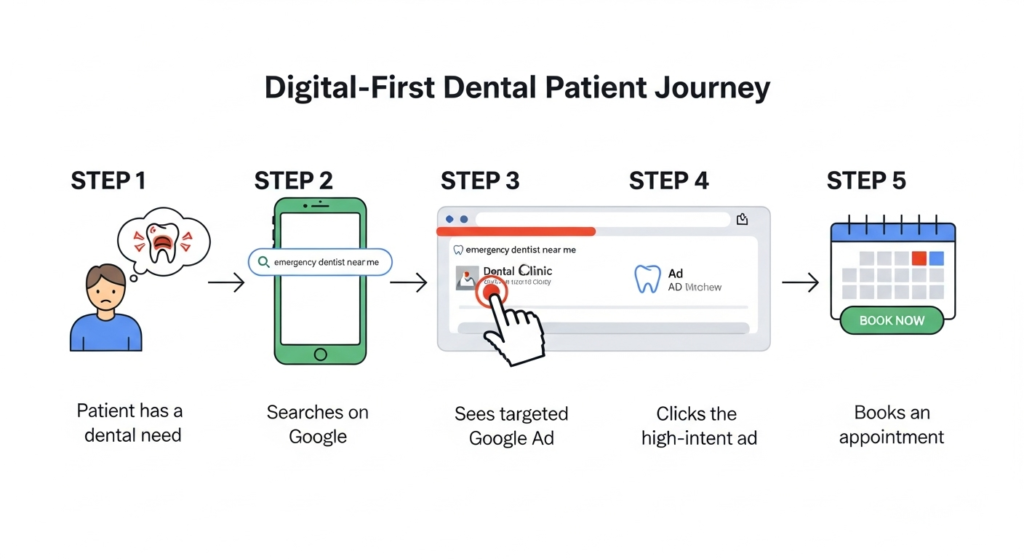
The modern patient’s path to your dental chair begins with a simple Google search.
The journey to your dental chair now begins with a digital search. Whether it’s a new resident looking for a family dentist, someone experiencing a sudden dental issue, or a person researching high-value procedures like cosmetic dentistry, their first action is to seek information online. They are actively looking for a solution, and your practice needs to be the one that provides it. This shift means your online presence is your new front door. A potential patient’s first impression is formed by what they see in the search results, making a top position invaluable. Unlike traditional marketing, which broadcasts a message to a wide, often uninterested audience, Google Ads allows you to intercept patients at the peak of their intent.
Beyond Traditional Marketing: The Immediate, Measurable Power of Dental PPC
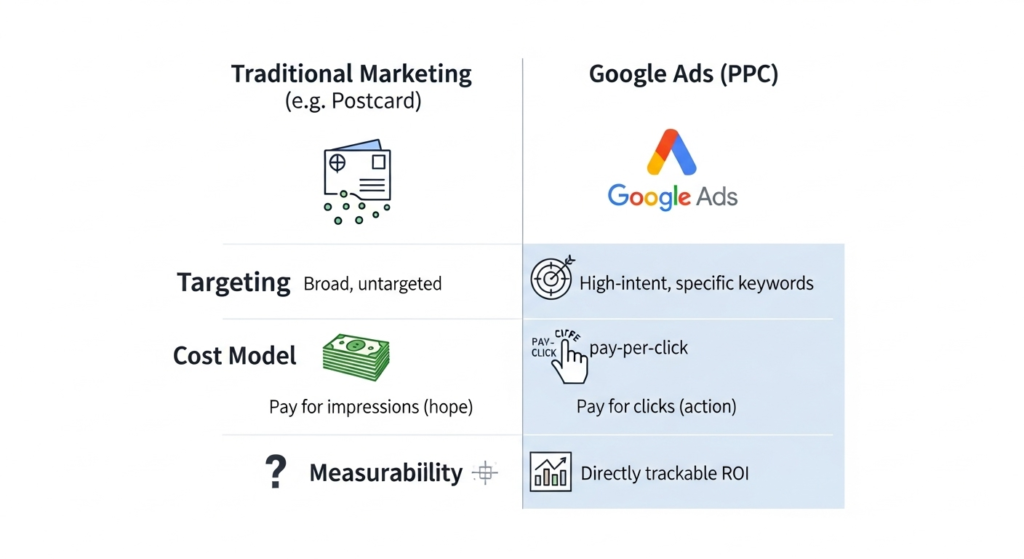
Google Ads transforms dental marketing from a guessing game into a predictable, data-driven growth engine.
Think about the limitations of a postcard mailer or a local magazine ad. You send it out and hope for the best, with little to no concrete data on who saw it, who acted on it, or what your exact return was. Dental PPC (Pay-Per-Click), the model behind Google Ads, flips this script entirely. You only pay when someone interested enough in your dental services clicks on your ad. This provides an immediate, direct line to potential patients. Furthermore, every single click, call, and form submission can be tracked. This measurability is a game-changer for dental practices, transforming marketing from a cost center into a predictable, profit-driving investment. In fact, 35% of traffic for dental offices comes from paid search ads, highlighting its crucial role in a diversified marketing strategy.
What This Strategic Blueprint Delivers: Consistent Patient Acquisition, ROI Visibility, and Long-Term Value for Your Practice
This blueprint is designed to deliver three core outcomes for your dental clinic. First, consistent patient acquisition. By systematically targeting the right keywords and demographics, you can create a steady flow of new patient inquiries, filling your schedule and reducing reliance on inconsistent referral streams. Second, complete ROI visibility. We will demystify the analytics and show you how to track not just clicks, but the actual cost to acquire a new patient, allowing you to make informed decisions about your marketing budget. Finally, we focus on long-term value. Acquiring a patient for a teeth whitening session can lead to a lifetime of routine check-ups, referrals, and more complex procedures, and your Google Ads strategy should reflect that high-value potential.
Laying the Foundation: Setting Up Your Strategic Google Ads Account
Before you spend a single dollar, a solid foundation is essential. A well-structured account is the difference between a high-performing patient acquisition machine and a frustrating, budget-draining experiment. This initial setup phase is where you translate your practice’s business goals into a coherent, manageable, and scalable Google Ads strategy.
Defining Your Goals: Targeting Specific Dental Services & Patient Acquisition Objectives
What do you want to achieve? The answer can’t just be “more patients.” Get specific. Are you looking to book more high-value procedures like dental implants or Invisalign? Do you want to increase the number of new patient cleanings to build your long-term patient base? Or perhaps you want to promote a seasonal teeth whitening special?
Your goals dictate your strategy. For instance, a campaign focused on emergency dental services will use different keywords, ad copy, and targeting than one promoting cosmetic dentistry. Define clear, measurable objectives, such as “Acquire 20 new dental implant consultations per month at a cost-per-acquisition under $250.” This clarity will guide every subsequent decision, from keyword selection to budget allocation.
Strategic Campaign Structure: Organizing Your Google Ads Account, Ad Groups, and Ad Campaigns
Think of your account structure as a filing cabinet. A messy cabinet makes it impossible to find anything; a well-organized one makes everything efficient. In Google Ads, the structure is: Account > Campaigns > Ad Groups > Ads & Keywords.
A common and effective strategy for dental practices is to structure campaigns around your core dental services.
- Campaign 1: General Dentistry (Ad Groups: “dentist near me,” “family dentist,” “dental check-up”)
- Campaign 2: Cosmetic Dentistry (Ad Groups: “teeth whitening,” “porcelain veneers,” “smile makeover”)
- Campaign 3: Restorative Dentistry (Ad Groups: “dental implants,” “dental crowns,” “root canal”)
- Campaign 4: Emergency Dentistry (Ad Groups: “emergency dentist,” “chipped tooth repair,” “toothache relief”)
This structure allows you to control budgets for each service category and tailor ad copy and landing pages specifically to the user’s search query, which is crucial for relevance and a high conversion rate.
Deep Dive into Precision Keyword Research for Dental Success
Keywords are the bedrock of your search ad campaigns. They are the queries your potential patients are typing into Google. Your goal is to match your services to their search intent.
Types of Keywords to Target:
- High-Intent, Service-Specific Keywords: These are your money-makers (e.g., “dental implants in [Your City],” “cost of teeth whitening,” “Invisalign provider near me”). Patients searching these terms are often further along in the decision-making process.
- Local General Keywords: These capture people looking for a new dentist in their area (e.g., “best dentist [Your Zip Code],” “dental clinic in [Your Neighborhood]”).
- Problem/Symptom-Based Keywords: These target users who know they have a problem but might not know the solution (e.g., “sharp pain in tooth,” “how to fix a chipped tooth”).
- Negative Keywords: Just as important are the keywords you don’t want to show up for. If you don’t accept certain insurance or don’t offer pediatric dentistry, add terms like “Medicaid dentist” or “children’s dentist” to your negative keyword list to avoid wasting your budget on irrelevant clicks.
Use tools like Google’s Keyword Planner to discover new keywords, see estimated search volumes, and get a sense of the average cost-per-click (CPC) for your target terms.
Crafting Compelling Ads: Attracting the Right Patients to Your Clinic
Once your foundation is set, it’s time to build the part of your campaign that patients actually see: the ads themselves. Your ad copy is your digital handshake. In just a few lines of text, you need to grab attention, communicate value, build trust, and persuade a user to click your ad over a competitor’s.
Writing High-Performing Ad Copy That Converts
Effective ad copy speaks directly to the searcher’s needs and sets your practice apart. Follow these core principles:
- Mirror the User’s Search: If someone searches for “emergency dentist,” your headline should include “Emergency Dentist” or “Emergency Dental Care.” This immediately confirms relevance.
- Highlight Your Unique Selling Propositions (USPs): What makes your dental clinic the best choice? Do you offer same-day appointments, use advanced technology, have outstanding patient reviews, or specialize in anxiety-free dentistry? Feature these prominently.
- Include a Strong Call-to-Action (CTA): Tell the user exactly what you want them to do next. Use action-oriented phrases like “Book Your Appointment Online,” “Call Now for a Free Consultation,” or “Schedule Your Visit Today.”
- Focus on Benefits, Not Just Features: Instead of saying “We use CEREC technology,” say “Get Your Permanent Crown in a Single Visit.” The benefit is what resonates with the patient. The average conversion rate for dental ads is 4.2%, and compelling, benefit-driven copy is key to exceeding that benchmark.
Leveraging Ad Assets (Extensions) for Maximum Visibility and Engagement
Ad Assets (formerly Extensions) are additional pieces of information that expand your ad, making it more prominent and useful. They cost nothing extra and significantly improve click-through rate (CTR) by giving users more reasons to choose your practice.
Essential Ad Assets for Dental Clinics:
- Sitelink Assets: Add links to specific pages on your website, like “Our Services,” “Meet the Doctor,” or “New Patient Specials.”
- Callout Assets: Highlight key benefits in short snippets, such as “Accepting New Patients,” “Financing Available,” or “5-Star Rated Practice.”
- Call Assets: Add your phone number directly to the ad, allowing users on mobile devices to call you with a single tap.
- Location Assets: Display your practice’s address, hours, and a link to Google Maps, which is crucial for attracting local patients.
- Structured Snippet Assets: Showcase a list of your services under a predefined header, such as “Services: Dental Implants, Teeth Whitening, Veneers, Root Canals.”
Modern Ad Formats: Harnessing Responsive Search Ads (RSAs) for Adaptability
Responsive Search Ads (RSAs) are now the default ad type in Google Search campaigns. Instead of writing a static ad, you provide Google with multiple headlines (up to 15) and descriptions (up to 4). Google’s machine learning then tests various combinations to find the best-performing ad for each individual search query.
This format allows for continuous optimization. By providing a wide range of headlines and descriptions—some focused on services, some on benefits, some on trust signals—you empower Google’s algorithm to assemble the most relevant and persuasive ad in real-time, improving your ad’s performance and click-through rate over time.
Understanding and Improving Your Quality Score: The Key to Lower Cost-Per-Click
Quality Score is Google’s rating (from 1 to 10) of the quality and relevance of your keywords and ads. It’s a crucial metric because it directly impacts your ad rank and how much you pay per click. A higher Quality Score means you can achieve a better ad position for a lower cost-per-click (CPC).
The three main components of Quality Score are:
- Expected Click-Through Rate (CTR): How likely is your ad to be clicked when shown? This is influenced by how compelling your ad copy is.
- Ad Relevance: How closely does your ad match the intent behind a user’s search? This is why tight ad groups are so important.
- Landing Page Experience: Is your landing page relevant, trustworthy, easy to navigate, and mobile-friendly?
Improving these three components not only boosts your Quality Score, lowering your advertising costs, but also creates a better experience for potential patients, increasing the likelihood they’ll convert.
Optimizing for Conversions: Turning Clicks into New Patients
Getting a click is only half the battle. The ultimate goal is to convert that click into a new patient appointment. This is where your website, specifically your landing pages, plays the starring role. A seamless, persuasive, and user-friendly experience after the click is non-negotiable for maximizing your ROI.
The Power of Dedicated Landing Pages for Dental Clinics
Never send ad traffic to your homepage. Your homepage is designed for general exploration, with multiple messages and navigation options. A landing page, in contrast, has one single, focused goal: to get the visitor to take a specific action (e.g., book an appointment, call your office).
For every ad group, you should have a dedicated landing page that mirrors the message of the ad. If a user clicks an ad for “dental implants,” the landing page should be exclusively about your dental implant services. It should feature:
- A clear, benefit-oriented headline that matches the ad.
- Information about the procedure, your expertise, and patient testimonials.
- A simple, prominent contact form or a clear “Book Now” button.
- Your phone number and address.
This laser-focus reduces distractions and guides the user directly toward conversion, dramatically increasing your conversion rate.
Implementing Robust Conversion Tracking for Accurate ROI
If you don’t measure it, you can’t improve it. Conversion tracking is the technical setup that tells Google Ads which clicks are leading to valuable patient actions. This is the only way to know if your ad campaigns are actually profitable.
You must track key conversion actions, including:
- Form Submissions: When a user fills out your “Request an Appointment” form.
- Phone Calls: Tracking calls made directly from your ads (using Call Assets) and calls made from the number on your landing page.
- Online Chat Engagements: If you use a chat widget to book appointments.
Accurate conversion tracking allows you to calculate your cost-per-acquisition (CPA) and see which keywords, ads, and campaigns are driving new patients. This data empowers you to optimize your budget by investing more in what works and cutting what doesn’t.
Enhancing the Patient Experience: User-Friendly Design and Mobile Responsiveness
The patient experience begins long before they enter your clinic; it starts on your landing page. A clunky, slow, or confusing website will send potential patients running to your competitors. With 57% of local searches coming from mobile devices, your landing pages must be designed with a mobile-first approach.
Ensure your pages load quickly, text is easy to read on a small screen, and buttons are large enough to tap with a thumb. Simplify your forms, asking only for the most essential information. Consider adding a “click-to-call” button that is always visible. The easier you make it for a potential patient to contact you, the more likely they are to do so. This is especially true when you consider that only 26% of dental practices offer online booking, giving you a significant competitive edge if you provide a seamless digital booking experience.
Strategic Bidding & Budget Management for Optimal ROI
Managing your budget and bidding strategy effectively is what separates profitable dental PPC campaigns from expensive ones. It’s about more than just setting a daily spend; it’s about allocating your resources intelligently to maximize the number of high-value patients you acquire while controlling costs. With the average patient acquisition cost ranging between $150 and $400 per new patient, a smart strategy is essential.
Smart Bidding Strategies for Dental Practices
Google’s automated “Smart Bidding” strategies use machine learning to optimize for conversions in each and every auction. For most dental practices, these are far more effective than manual bidding.
Popular Smart Bidding strategies include:
- Maximize Conversions: Google will aim to get you the most conversions (e.g., appointments booked) possible within your daily budget. This is a great starting point for new campaigns.
- Target CPA (Cost Per Acquisition): You tell Google the maximum amount you’re willing to pay for a new patient, and it will try to hit that average. This provides more control over your acquisition costs once you have enough conversion data.
- Enhanced CPC (Cost Per Click): This is a semi-automated strategy where Google adjusts your manual bids up or down based on the likelihood of a click leading to a conversion.
Choosing the right strategy depends on your campaign goals and the amount of historical data you have. Start with Maximize Conversions and consider moving to Target CPA once you have a clear understanding of your performance.
Intelligent Budget Allocation Across Dental Services
Not all dental services are created equal in terms of revenue and profitability. A dental implant patient has a much higher lifetime value than a patient coming in for a routine cleaning. Your budget allocation should reflect this reality.
Structure your campaigns by service category (as discussed earlier) to control how much you spend on each. You might allocate a larger portion of your budget to your “Dental Implants” and “Cosmetic Dentistry” campaigns, as these attract higher-value cases. For general dentistry, you might set a lower budget with a stricter Target CPA, focusing on acquiring new long-term patients more cost-effectively. This portfolio approach ensures you’re fueling your most profitable service lines while still building a broad patient base.
Understanding and Optimizing Cost-Per-Click (CPC)
Cost-Per-Click (CPC) is the amount you pay each time someone clicks your ad. This cost is determined by a live auction system and is influenced by your bid, your Quality Score, and your competitors’ bids. While you don’t have direct control over the CPC, you can influence it.
The single best way to lower your average CPC is by improving your Quality Score. A highly relevant ad and landing page (high Quality Score) are rewarded by Google with a lower CPC. This means focusing on creating tightly-themed ad groups, writing compelling ad copy that matches keyword intent, and ensuring your landing pages provide an excellent user experience. Continuously refining these elements is the key to making your ad spend more efficient over time and achieving a better ROI.
Advanced Strategies for Amplified Patient Acquisition and Growth
Once you’ve mastered the fundamentals, you can layer on advanced strategies to further enhance your reach, re-engage interested prospects, and maximize your campaign efficiency. These tactics move beyond simple keyword targeting to connect with potential patients in more sophisticated ways across the Google ecosystem.
Remarketing: Re-Engaging Interested Prospects Who Visited Your Dental Website
How many times have you visited a website, gotten distracted, and left without taking action? Your potential patients are no different. Remarketing (or retargeting) allows you to show targeted ads to people who have previously visited your website but didn’t book an appointment.
You can create display ads that follow these users as they browse other websites in the Google Display Network, gently reminding them of your practice. A remarketing campaign could show a special offer for “New Patient Check-ups” to someone who visited your services page or ads for “Dental Implant Consultations” to someone who spent time on your implants landing page. It’s a highly effective way to stay top-of-mind and bring warm leads back to convert.
Beyond Keywords: Strategic Audience Targeting Options
While search campaigns are keyword-focused, Google Ads offers powerful audience targeting options that can be layered on top to refine who sees your ads. This allows you to reach specific demographics and user groups who are more likely to become your ideal patients.
Audience targeting options include:
- In-Market Audiences: Target users who Google’s data indicates are actively researching and considering purchasing specific products or services. For dentists, the “Dental Services” in-market audience is a perfect fit.
- Affinity Audiences: Reach people based on their long-term interests and habits.
- Demographic Targeting: Narrow your audience by age, gender, parental status, and household income to align with your ideal patient profile for certain high-value services.
- Custom Audiences: You can create your own audiences by inputting URLs of competitor websites or apps your ideal patients might use.
Performance Max (PMax) Campaigns: The Future of Integrated Ads for Dental Clinics
Performance Max (PMax) is Google’s newest, all-in-one campaign type. You provide Google with your conversion goals, budget, and creative assets (text, images, videos), and its AI will automatically run ads across all of Google’s channels—Search, Display, YouTube, Gmail, Discover, and Maps—to find you the most conversions.
For dental clinics, PMax can be a powerful tool for finding new pockets of potential patients you might not have reached otherwise. It’s particularly effective for promoting visual services like cosmetic dentistry, where images and videos can be highly persuasive. While it offers less manual control, it complements your existing search campaigns by maximizing your reach and leveraging the full power of Google’s automation.
Integrating Local Service Ads (LSAs): Standing Out on Google Maps and Search Engine Results Pages
Local Service Ads (LSAs) are a separate, pay-per-lead platform designed for local service businesses, including dentists. These ads appear at the very top of Google search results, even above traditional Google Ads, and feature a “Google Screened” badge that builds instant trust.
With LSAs, you don’t pay for clicks; you pay for qualified leads—meaning actual phone calls from potential patients seeking your services. To qualify, your practice must undergo a background check process by Google. Once approved, LSAs provide unparalleled visibility for local searches like “dentist near me.” They are an essential component of a comprehensive local patient acquisition strategy and work in tandem with your standard search campaigns.
Measuring Success & Proving ROI: Your Dental Clinic’s Bottom Line
The ultimate measure of your Google Ads success isn’t clicks or impressions; it’s the tangible impact on your practice’s growth and profitability. Proving this requires a deep understanding of the right metrics and a commitment to data-driven decision-making. The average Google Ads ROI is 200%, and with a strategic approach, dental practices can often exceed this figure.
Key Performance Indicators (KPIs) for Dental Google Ads
While there are dozens of metrics available, focus on the KPIs that directly reflect your business goals:
- Conversions: The total number of new patient leads (form fills, phone calls). This is your primary measure of volume.
- Cost Per Conversion (CPA): The average cost to generate one new patient lead (Total Spend / Total Conversions). This is your primary measure of efficiency.
- Conversion Rate: The percentage of clicks that result in a conversion (Conversions / Clicks). This tells you how effective your landing pages and ads are at persuading visitors.
- Click-Through Rate (CTR): The percentage of impressions that result in a click (Clicks / Impressions). This indicates the relevance and appeal of your ad copy. The average CTR for dental services in search ads is 5.38%, which serves as a good benchmark.
- Impression Share: The percentage of time your ads were shown out of the total times they were eligible to be shown. A low impression share might indicate your budget is too low or your bids are not competitive enough.
Advanced Reporting and Analytics with Google Analytics 4
While Google Ads provides great data, integrating it with Google Analytics 4 (GA4) gives you a more holistic view of the patient journey. GA4 can show you what users do after they click your ad and land on your site. You can track how long they stay, which other pages they visit, and whether they return later. This information is invaluable for understanding patient behavior and optimizing your website’s user experience. By setting up event tracking in GA4, you can measure micro-conversions, like video views or PDF downloads of new patient forms, giving you deeper insight into user engagement and the effectiveness of your overall digital marketing efforts.
Final Thoughts
Navigating the world of Google Ads can seem complex, but as we’ve seen, it’s a powerful and predictable engine for growth when approached with a clear strategy. The opportunity for dental practices is immense. The U.S. dental services market was valued at USD 192.22 billion in 2023 and continues to grow, fueled by a patient population that increasingly begins its search for care online.
The key takeaway from this blueprint is to move beyond simply “running ads” and adopt a strategic, ROI-focused mindset. This means building a solid foundation with a logical campaign structure and precise keyword research. It means crafting compelling, patient-centric ad copy and directing that traffic to high-converting, dedicated landing pages. It requires intelligent budget management, leveraging automation through Smart Bidding, and allocating your resources to your most valuable dental services.
Your next steps are clear:
- Audit Your Foundation: Review your current campaign structure. Is it organized by service? Is your conversion tracking accurate?
- Refine Your Patient-Facing Assets: Read your ad copy and landing pages. Do they speak directly to patient needs and clearly state why they should choose your practice?
- Embrace Data: Commit to regularly reviewing your key performance indicators. Make decisions based not on gut feelings, but on what the data tells you about your cost per patient acquisition and overall return.
By implementing the strategies outlined in this guide, you can transform your Google Ads account from a simple advertising tool into the strategic cornerstone of your patient acquisition efforts, ensuring a consistent flow of new patients and a healthy, growing practice for years to come.


