Choosing the Right PPC Services Company: Your Guide to Strategic Growth
Choosing the Right PPC Services Company: Your Guide to Strategic Growth
Introduction: Navigating the Landscape of Strategic PPC Growth
Choosing the right partner for any critical business function is a decision that shapes your future. When it comes to digital growth, this is especially true. In a world where online visibility can make or break a company, Pay-Per-Click (PPC) advertising stands out as a powerful lever for immediate impact. But wielding that lever effectively requires more than just a budget; it demands strategy, expertise, and a deep understanding of a constantly evolving digital landscape. This guide is designed to be your authoritative resource, moving beyond the surface-level definitions to give you the strategic framework needed to select a PPC services company that won’t just manage your ads, but will become a true partner in your growth journey.
The Promise of PPC: Immediate Visibility, Targeted Reach, and Measurable Results
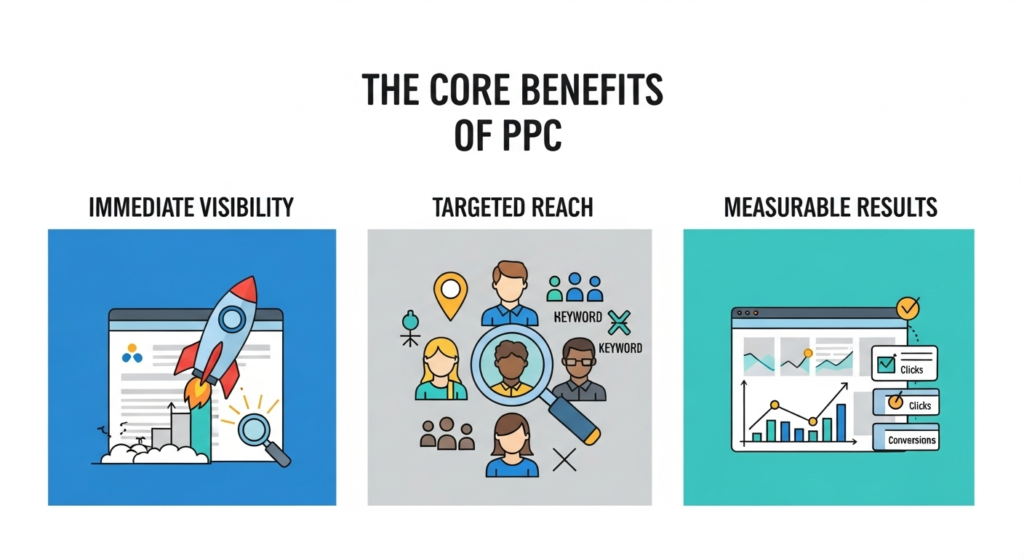
PPC advertising delivers a powerful combination of immediate visibility, precise audience targeting, and fully measurable results.
At its core, PPC marketing is a model of internet advertising where you pay a fee each time one of your ads is clicked. It’s a way of buying visits to your site, rather than attempting to “earn” those visits organically through search engine optimization (SEO). For businesses eager to make an impact, the appeal is undeniable. While SEO is a long-term marathon, PPC is a sprint to the top of the search engine results page (SERP).
This immediate visibility is just the beginning. The true power of PPC lies in its precision. You can target potential customers based on specific keywords they search for, their geographic location, their demographic information, and even their past online behaviors. This means your marketing dollars are spent reaching people who are already actively looking for the solutions you provide. Furthermore, every aspect of a PPC campaign is measurable. From clicks and impressions to the ultimate conversion, you can track the return on every dollar spent, allowing for data-driven decisions that refine and improve performance over time.
Why Choosing the Right Partner is Crucial for Sustained Business Growth
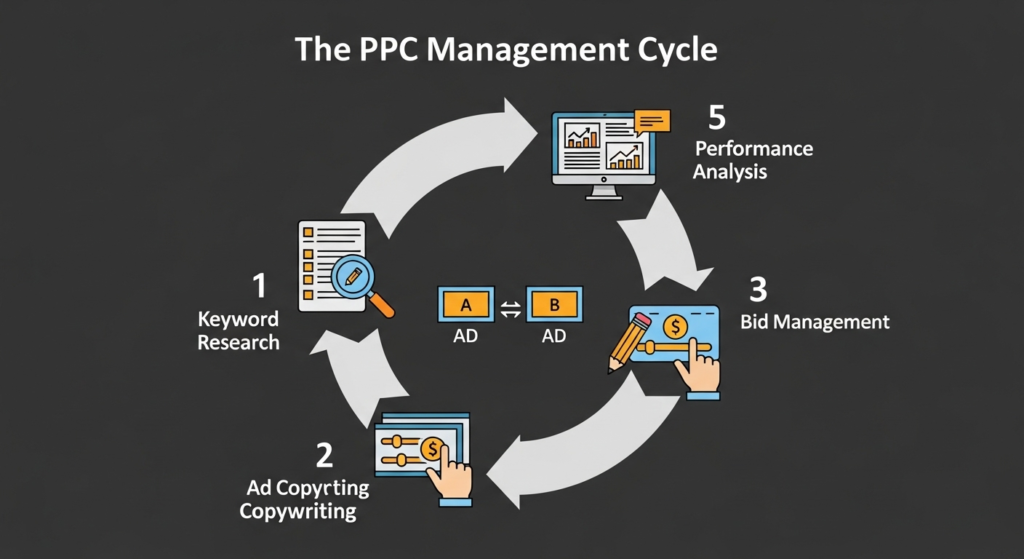
Effective PPC management is not a single task but a continuous cycle of strategic activities requiring specialized expertise.
If PPC is so straightforward, why not just manage it in-house? The reality is that the simplicity of the concept belies a deep complexity in execution. The digital advertising ecosystem, dominated by platforms like Google and Amazon, is fiercely competitive and constantly changing. Managing a successful PPC strategy involves intricate keyword research, compelling ad copywriting, sophisticated bid management, rigorous A/B testing, and continuous performance analysis.
This is where a strategic partner becomes invaluable. The right PPC services company isn’t just a vendor that executes tasks; they are an extension of your marketing team. They bring specialized expertise, proprietary tools, and a wealth of experience from working across various industries. They understand the nuances of platform algorithms, the psychology of user intent, and how to translate raw data into actionable insights. Choosing the right partner means the difference between simply spending money on clicks and strategically investing in a system that generates predictable leads, sales, and sustainable business growth.
What This Guide Will Help You Achieve
This comprehensive guide will walk you through the entire process of selecting the right PPC partner for your unique business needs. We will demystify the world of PPC and provide you with a clear, actionable framework. By the end, you will be able to:
- Understand how PPC functions as a strategic engine for growth, not just an advertising channel.
- Identify the key moments when partnering with an agency provides a distinct competitive advantage.
- Utilize a step-by-step process for evaluating and choosing a PPC company.
- Recognize the essential services a top-tier agency should offer.
- Spot the red flags and debunk the common myths that can lead to costly mistakes.
Our goal is to empower you to make an informed, confident decision that lays the foundation for a fruitful partnership and drives measurable success for your business.
Understanding PPC as a Strategic Growth Engine
To choose the right partner, you first need to reframe your perspective on what PPC truly is. It’s not an isolated tactic or a simple line item in your marketing budget. When managed correctly, PPC is a dynamic and powerful engine for strategic growth, capable of fueling everything from market entry and brand awareness to lead generation and customer acquisition. The global ad spending in the search advertising market is projected to reach $351.55 billion in 2025, a testament to its central role in modern business strategy.
Beyond Clicks: How PPC Drives Real Business Value and Marketing Objectives
The most common mistake businesses make is equating PPC success with a high volume of clicks. Clicks are merely the first step; they are a means to an end, not the end itself. The real value of PPC is unlocked when those clicks lead to meaningful business outcomes—a concept often referred to as a conversion. A conversion can be anything you define as valuable: a completed purchase, a submitted contact form, a newsletter signup, or a phone call.
A strategically-managed PPC campaign is laser-focused on driving these conversions. It’s about attracting the right clicks from users with high purchase intent. This is where the magic happens. By optimizing for conversions, you’re not just buying traffic; you’re acquiring customers and generating revenue. This focus on tangible results allows PPC to directly support core business objectives, such as:
- Increasing Sales Revenue: Driving qualified traffic directly to product pages or lead forms.
- Generating High-Quality Leads: Targeting specific professionals or decision-makers searching for B2B solutions.
- Building Brand Awareness: Gaining prominent visibility for key search terms related to your industry.
- Testing New Markets: Quickly and affordably gauging demand in new geographic or demographic segments.
- Promoting Specific Offers: Launching targeted campaigns around new products, sales, or events.
The Core Benefits of Integrating PPC into Your Growth Strategy
Integrating PPC into your broader marketing strategy, sometimes called the “Marketing Masala” for the way different elements blend to create a richer result, yields several powerful benefits. PPC traffic often has a higher conversion potential, with some studies showing that PPC traffic converts 50% better than organic traffic. This is because it captures users at the very moment of their highest intent.
-
- Speed and Agility: Unlike organic strategies that can take months to show results, PPC campaigns can be launched within days, providing immediate data and traffic. This agility allows you to respond quickly to market changes, competitor actions, or new opportunities.
- Unmatched Targeting Capabilities: PPC platforms offer granular control over who sees your ads. You can target users by the keywords they search, their location, age, interests, and even if they’ve visited your website before (via remarketing). This ensures your message reaches the most relevant audience possible.
- Data-Driven Optimization: PPC is a goldmine of data. Every click, impression, and conversion provides valuable information about your customers’ behavior and preferences. This data can be used not only to refine your PPC campaigns but also to inform your overall marketing and business strategy.
- Budgetary Control: You have complete control over your spending. You can set daily or monthly budgets, control how much you’re willing to pay per click, and pause or adjust campaigns at any time. This makes PPC a scalable channel that can grow with your business.
Key PPC Channels for Diverse Strategic Growth
While Google is the undisputed giant of search engine marketing, a comprehensive PPC strategy often involves a multi-platform approach tailored to where your specific audience spends their time.
- Google Ads: This is the cornerstone of most PPC strategies. It allows you to place ads across Google’s vast network, including Search, Display, YouTube, and Gmail. Within Google Ads, you can run highly effective shopping campaigns for e-commerce, which display product images and prices directly in search results, or even target users on Google Play to drive app installs.
- Amazon PPC: For any business selling products on Amazon, Amazon PPC is non-negotiable. It allows you to promote your products directly within Amazon’s search results and product pages, reaching customers who are in the final stages of the buying cycle.
- Social Media Advertising: Platforms like Meta (Facebook and Instagram), LinkedIn, X (formerly Twitter), and Pinterest offer powerful PPC options. While search ads capture intent, social ads excel at creating demand by targeting users based on their demographics, interests, and behaviors. The projected global social media ad spend of $276 billion in 2025 underscores its importance.
- Bing Ads (Microsoft Advertising): While smaller than Google, Bing still commands a significant portion of the search market, particularly among certain demographics. It often offers lower competition and cost-per-click, making it a valuable addition to a diversified PPC portfolio.
When to Partner with a PPC Services Company for Strategic Advantage
The decision to outsource your PPC management is a significant one. While some businesses can manage in-house, especially in the very early stages, there comes a point where the complexity, time commitment, and strategic depth required to achieve a competitive return on investment (ROI) necessitate professional expertise. Recognizing this inflection point is key to unlocking the next level of growth.
Identifying Your Business’s Growth Stage and Needs
Your current business stage often dictates the right time to seek a partner.
- Startup/Early Stage: You might be running campaigns yourself, focusing on learning the basics. However, if you’re venture-backed or have aggressive growth targets, bringing in an expert early can prevent costly mistakes and establish a strong foundation. You need a partner who can be nimble and focus on proving the model.
- Growth Stage: Your business is scaling, and so are your marketing efforts. You likely have too much on your plate to give PPC the daily attention it needs. Your budget is increasing, and the cost of mismanagement becomes significant. You need a partner who can scale your campaigns, optimize for efficiency, and integrate PPC with other channels.
- Established/Enterprise: You have a mature marketing team, but may lack the specialized, in-the-weeds PPC expertise. Your campaigns are complex, spanning multiple channels and regions. You need a strategic partner who can provide high-level strategy, advanced analytics, and a competitive edge through cutting-edge tactics and technology.
If you find yourself hitting a performance plateau, struggling to scale your budget effectively, or simply lacking the time to keep up with platform changes, it’s a strong signal that it’s time to partner with a specialist.
The Value an Expert Google AdWords Agency Brings
Partnering with a dedicated PPC agency, often referred to as a Google AdWords agency due to the platform’s dominance, brings a host of benefits that are difficult to replicate in-house without significant investment.
- Deep Specialization: PPC is all they do. They live and breathe the platforms, staying on top of every algorithm update, new feature, and emerging trend. This specialized knowledge translates directly into better campaign performance.
- Access to Advanced Tools: Professional agencies invest in expensive, sophisticated software for keyword research, competitor analysis, bid management, and reporting that are often out of reach for individual businesses.
- Cross-Industry Experience: An agency has seen what works (and what doesn’t) across hundreds of campaigns in various industries. This broad perspective allows them to apply proven strategies to your business while avoiding common pitfalls.
- Dedicated Time and Resources: A successful PPC campaign requires constant monitoring and optimization. An agency provides a team of experts whose sole focus is maximizing the performance of your account, freeing you and your team to focus on other core business functions.
- Objective, Data-Driven Perspective: An external partner can provide an unbiased view of your marketing efforts, challenging assumptions and making decisions based purely on performance data, free from internal politics or emotional attachment to certain strategies.
The Essential Framework for Choosing the Right PPC Partner
Selecting a PPC company shouldn’t be a leap of faith. It requires a structured, deliberate process designed to find a partner whose expertise, approach, and culture align with your business goals. This five-step framework will guide you through the evaluation process, ensuring you ask the right questions and look for the right signals.
Step 1: Clearly Define Your Strategic Goals and Expectations
Before you even start looking at agencies, you must first look inward. You cannot evaluate a potential partner if you don’t know what you want to achieve. Vague goals like “get more traffic” or “increase sales” are not enough. You need specific, measurable, achievable, relevant, and time-bound (SMART) goals.
Are you focused on:
- Lead Generation? If so, what is your target cost per conversion (or cost per lead)?
- E-commerce Sales? What is your target Return on Ad Spend (ROAS)?
- Brand Awareness? How will you measure success (impressions, share of voice, brand lift)?
- Market Penetration? Are you trying to enter a new geographic area or launch a new product?
Clearly defining your Key Performance Indicators (KPIs) is critical. The right agency will want to understand these goals deeply and build their entire strategy around them. This initial step ensures that you and your future partner are aligned on what success looks like from day one.
Step 2: Assess Their Expertise, Experience, and Strategic Acumen
Once your goals are clear, you can begin evaluating an agency’s qualifications. This goes beyond simply looking at the services they list on their website.
- Proven Track Record: Ask for case studies and client testimonials that are relevant to your industry, business model (B2B/B2C/E-commerce), and goals. Look for evidence of long-term partnerships, as this indicates client satisfaction and sustained results.
- Team and Certifications: Who will actually be working on your account? Inquire about the experience level of the team members. Are they certified in Google Ads, Microsoft Advertising, or other relevant platforms? A strong agency will be proud to showcase the expertise of their people.
- Industry Specialization: While not always necessary, an agency with experience in your specific niche can be a significant advantage. They will already understand your target audience, competitive landscape, and the terminology that resonates with your customers.
- Forward-Thinking Approach: The world of PPC is being reshaped by artificial intelligence. Ask potential partners about their approach to AI and automation. Do they understand its role in bid management and audience targeting? A forward-thinking agency will be able to discuss how they leverage these technologies to gain a competitive edge. The adoption of AI in PPC is expected to climb to 70% in 2024, making this a crucial point of differentiation.
Step 3: Evaluate Their Strategic Approach to Campaign Management
This is where you separate the tacticians from the strategists. A mediocre agency will talk about setting up keywords and ads. A great agency will talk about your business.
- Onboarding and Discovery Process: How do they begin a new partnership? A top-tier agency will have a thorough discovery process to understand your business, customers, competitive landscape, and unique value proposition. They should be asking you more questions than you ask them.
- Strategy vs. Execution: Probe into how they would approach your account. Ask them to outline a high-level strategy. Their answer should be tailored to the goals you defined in Step 1 and should focus on business outcomes, not just campaign metrics.
- Proactive Optimization: PPC is not “set it and forget it.” Ask about their optimization process. How often do they review accounts? What specific levers do they pull to improve performance? Their answer should include discussions on bid adjustments, ad copy testing, negative keyword expansion, and audience segmentation.
- Focus on the Full Funnel: A truly strategic partner understands that the click is just one part of the customer journey. Do they ask about your landing pages? Do they have expertise in Conversion Rate Optimization (CRO) and improving Landing Page Conversion rates? An agency that focuses only on driving clicks without caring what happens after is only doing half the job.
Step 4: Transparency, Communication, and Reporting Standards
A successful partnership is built on trust, and trust is built on transparency and clear communication.
- Reporting: Ask to see a sample report. Is it a data dump of meaningless metrics, or does it provide clear insights and analysis? The report should connect campaign performance directly back to your business goals. It should explain the “what,” the “so what,” and the “now what.”
- Communication Cadence: How often will you hear from them? Establish expectations for regular meetings (weekly, bi-weekly, or monthly) and ad-hoc communication. Who will be your primary point of contact, and how accessible are they?
- Account Ownership: Clarify who owns the ad accounts (e.g., your Google Ads account). You should always retain ownership of your accounts and historical data. An agency that insists on creating an account under their own ownership is a major red flag.
- Transparency in Work: Will you have full access to your accounts to see the changes they are making? A transparent partner will welcome your involvement and have nothing to hide.
Step 5: Understanding Pricing Models and Their Focus on Your ROI
Finally, you need to understand the financial aspect of the partnership. While cost is a factor, it should not be the primary driver of your decision. The cheapest option is rarely the best value.
Common pricing models include:
- Percentage of Ad Spend: The most common model, where the agency fee is a percentage of your monthly ad budget.
- Flat Retainer: A fixed monthly fee, which provides predictable costs.
- Performance-Based: A model where the agency’s fee is tied directly to the results they generate (e.g., per lead or per sale). This can be great but requires very clear definitions and tracking.
The key is to find a model that aligns the agency’s incentives with your own. A good partner is focused on delivering a strong return on your total investment (ad spend + agency fees). They should be able to articulate how their work will generate value far exceeding their cost.
Key Services a Top PPC Company Should Offer (with a Strategic Lens)
When you partner with a PPC services company, you’re investing in a suite of specialized capabilities. A premier agency moves beyond basic management to offer a holistic set of services, all viewed through the lens of achieving your strategic business objectives. Here’s what to look for.
Comprehensive Keyword Research and Strategy
Keywords are the foundation of any search-based PPC campaign. A top agency doesn’t just plug a few ideas into the Google Keywords Planner. Their process is far more strategic. They delve into user intent, distinguishing between informational, navigational, and transactional queries to target users at the right stage of the buying journey. They conduct extensive competitor analysis to identify gaps and opportunities. The strategy should include a mix of broad “head” terms for volume and highly specific “long-tail” keywords that often have higher conversion rates. This isn’t a one-time task but an ongoing process of discovery, refinement, and expansion.
Compelling Ad Copy and Creative Development
Having the right keywords is useless if your ads don’t compel users to click. An expert PPC partner has a deep understanding of copywriting and user psychology. They craft ad headlines and descriptions that are not only relevant to the search query but also highlight your unique value proposition and include a strong call-to-action. Critically, this process is data-driven. They will continuously A/B test different ad variations to identify which messages resonate most with your audience, constantly striving to improve the Click Through Rate (CTR) and Quality Score, which in turn can lower your costs.
Advanced Bid Management and Optimization
At its heart, PPC is an auction. How you bid determines your ad position and cost. A top agency employs sophisticated bid management strategies that go far beyond simple manual bidding. They leverage a combination of automated bidding strategies (like Target CPA or Target ROAS) and manual overrides based on performance data. They will implement bid adjustments based on factors like device type, time of day, geographic location, and audience demographics. Their goal is always to maximize your budget’s efficiency, ensuring every dollar is spent in the most effective way possible to lower the cost per conversion.
Landing Page Optimization and A/B Testing
A strategic PPC company knows their job doesn’t end with the click. The user experience after the click is paramount to achieving a conversion. They will provide expert guidance on your landing pages, ensuring that the message is consistent with the ad, the design is clean, the call-to-action is clear, and the page is optimized for conversions. This service, known as Conversion Rate Optimization (CRO), is a hallmark of a results-focused agency. They will often recommend and help implement A/B testing for different landing page elements—like headlines, images, or form fields—to systematically improve your Landing Page Conversion rate.
Strategic Campaign Monitoring, Analysis, and Reporting
Data is the lifeblood of PPC. A leading agency will have a robust campaign monitoring system in place to track performance in near real-time. But they don’t just report the numbers; they interpret them. Their reports will provide actionable insights, highlighting what’s working, what’s not, and what steps are being taken to improve performance. They connect campaign metrics to your overarching business goals, translating data into a clear story of progress and ROI. This strategic analysis is what separates a mere manager from a true growth partner.
Diverse Campaign Types and Platform Expertise
The PPC landscape is diverse, and a top company will have expertise across a range of campaign types and platforms to match your specific needs. This includes:
- Search Campaigns: The bread and butter of PPC, targeting users based on keywords.
- Display Campaigns: Visual ads placed across a network of websites to build brand awareness.
- Shopping Campaigns: Essential for e-commerce businesses to showcase products directly in search results.
- Remarketing Campaigns: Re-engaging users who have previously visited your website but did not convert.
- Video Campaigns: Leveraging platforms like YouTube to reach a massive, engaged audience.
Their expertise should extend beyond Google to include Amazon PPC if you’re an e-commerce seller, and various social media advertising platforms if that’s where your audience resides.
Red Flags to Watch Out For & Common PPC Myths Debunked
Navigating the search for a PPC partner can be challenging, as the industry has its share of providers who overpromise and underdeliver. Being aware of common red flags and pervasive myths can protect you from making a poor investment and set you up for a successful partnership.
Agencies Promising Instant, Unrealistic Results or Guaranteed Rankings
This is perhaps the biggest red flag. No reputable agency can guarantee a #1 ranking or specific results overnight. PPC performance is influenced by dozens of factors, including your industry, competition, budget, and website quality. An honest agency will talk about a process of testing, learning, and gradual optimization. They will set realistic expectations and focus on a strategy for sustained growth, not on “get rich quick” promises. If it sounds too good to be true, it almost certainly is.
Lack of Transparency or Poor Communication Practices
A healthy partnership is built on a foundation of open communication and transparency. Be wary of any agency that is cagey about their process, refuses to give you full access to your own ad accounts, or provides vague, confusing reports. You should always know what work is being done on your behalf and how your money is being spent. A prospective partner who is a poor communicator during the sales process will almost certainly be a poor communicator once you’ve signed a contract.
The “Set It and Forget It” Approach to Campaign Management
Effective PPC marketing is an active, ongoing process. It requires constant monitoring, analysis, and optimization. An agency that suggests they can simply set up your campaigns and let them run on autopilot is not providing real value. The digital landscape changes daily, with new competitor tactics, shifting consumer behavior, and platform updates. A dedicated partner is continuously working to refine your campaigns, test new approaches, and capitalize on emerging opportunities to stay ahead of the curve.
Myth: PPC is Only for Big Budgets (Strategic PPC can scale for businesses of all sizes)
One of the most persistent myths is that you need a massive budget to succeed with PPC. While a larger budget provides more data and allows for faster testing, the beauty of PPC is its scalability. Even small to mid-sized companies can achieve significant results with a strategic, well-managed campaign. For small businesses, the average monthly PPC campaign cost can range from $100 to $10,000, demonstrating its accessibility. The key is not the size of the budget, but the efficiency with which it’s used. A skilled agency can make a smaller budget work harder by focusing on highly specific long-tail keywords, tight geographic targeting, and optimizing for conversions, ensuring a positive ROI at any scale.
Final Thoughts
Choosing the right PPC services company is one of the most critical marketing decisions you will make. It’s an investment not just in advertising, but in a strategic partnership that can become a primary driver of your business’s growth. The journey requires moving beyond a simplistic view of PPC as a tool for buying clicks and embracing it as a sophisticated engine for acquiring customers and generating real, measurable value.
The key takeaway from this guide is to approach your selection process with a strategic mindset. It begins with a deep understanding of your own goals. It’s about finding a partner who is as obsessed with your business outcomes—your leads, sales, and ROI—as you are. This means looking for a company that prioritizes Conversion Rate Optimization, demonstrates a transparent and communicative approach, and has the expertise to manage a diverse portfolio of campaigns across platforms like Google and Amazon PPC.
As you move forward, remember that the digital marketing landscape is in constant flux. The rise of AI and machine learning is transforming how campaigns are managed and optimized. Therefore, your ideal partner must not only be an expert in today’s best practices but also a forward-thinker preparing for the future. They should be a guide who can help you navigate the complexities of search engine marketing and turn challenges into opportunities.
Your next steps are clear:
- Define Your Goals: Solidify your specific, measurable business objectives for PPC.
- Do Your Research: Use the framework provided to identify and vet a shortlist of potential agencies.
- Ask the Tough Questions: Don’t be shy. Probe into their strategy, process, and past results.
- Choose a Partner, Not a Vendor: Select the company that you believe will integrate seamlessly with your team and genuinely invest in your success.
By following this disciplined approach, you can forge a powerful alliance that will not only elevate your PPC performance but will also serve as a catalyst for achieving your most ambitious growth targets.


