Expert PPC Services: Maximize ROI with Strategic Pay-Per-Click Advertising
Expert PPC Services: Maximize ROI with Strategic Pay-Per-Click Advertising
In the world of digital marketing, the promise of instant results is both alluring and elusive. You’ve heard the pitch: launch a Pay-Per-Click (PPC) campaign today, and watch the traffic roll in tomorrow. While it’s true that PPC advertising can open the floodgates to your website, simply paying for clicks is a surefire way to drain your budget with little to show for it. The real value, the kind that transforms ad spend into predictable revenue, lies beyond the click. It’s found in strategy, precision, and a relentless focus on Return on Investment (ROI).
This guide is designed to be your authoritative resource on navigating the complexities of PPC. We’ll move past the surface-level metrics and dive deep into what it truly takes to build, manage, and optimize a PPC machine that fuels sustainable growth. We will explore how expert PPC services bridge the critical gap between spending money on ads and strategically investing in your bottom line. Whether you’re new to the space or looking to refine an existing approach, you’ll find the insights needed to maximize your ROI and make every click count.
Introduction: Beyond Clicks – The Imperative of Strategic PPC for ROI
The Digital Marketing Landscape: Navigating for Growth
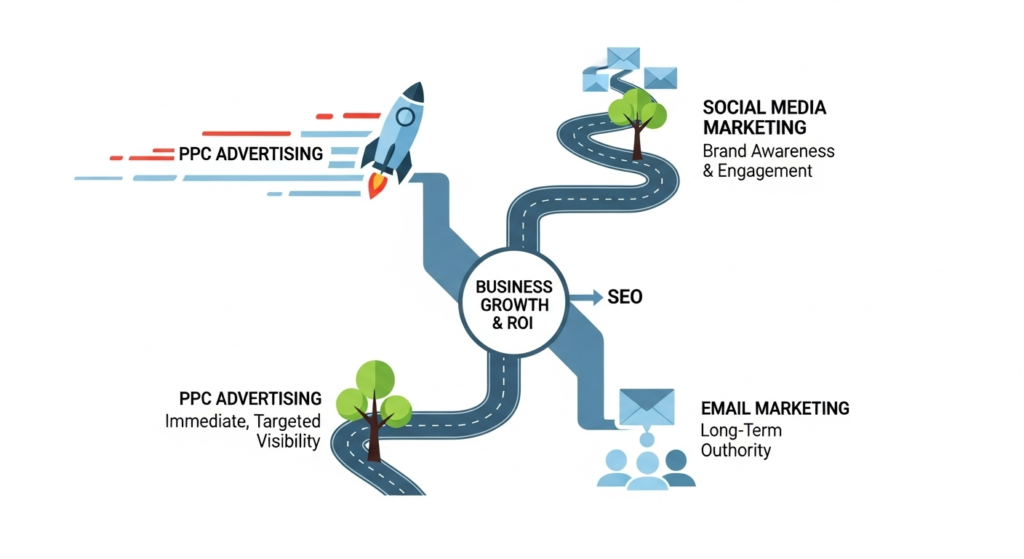
PPC is a powerful component in a multi-channel strategy, providing the fastest path to targeted visibility and growth.
The modern digital marketing ecosystem is a bustling, competitive arena. Businesses are all vying for the same thing: the attention of their ideal customers. Search Engine Optimization (SEO) is a powerful long-term play, building foundational authority. Social media marketing creates community and brand awareness. Email marketing nurtures leads. But when you need immediate, targeted visibility, nothing delivers quite like PPC advertising. It’s the express lane on the digital highway, allowing you to place your message directly in front of users actively searching for solutions you provide. In this dynamic landscape, a multi-channel approach is key, and PPC is an indispensable component for driving rapid, measurable growth.
The Promise of Pay-Per-Click (PPC) Advertising: Instant Traffic and Visibility
At its core, the promise of PPC is simple and powerful. You create an ad, bid on relevant keywords, and when a user on a search engine like Google types in that query, your ad can appear at the top of the results. You only pay when someone actually clicks on your ad, hence “Pay-Per-Click.” This model offers unparalleled control and speed. Unlike organic strategies that can take months to yield results, a well-structured PPC campaign can start driving targeted traffic to your website within hours of launch. This immediate visibility is crucial for product launches, promotional campaigns, or any business that needs to generate leads and sales now.
The ROI Gap: Why Most PPC Campaigns Underperform
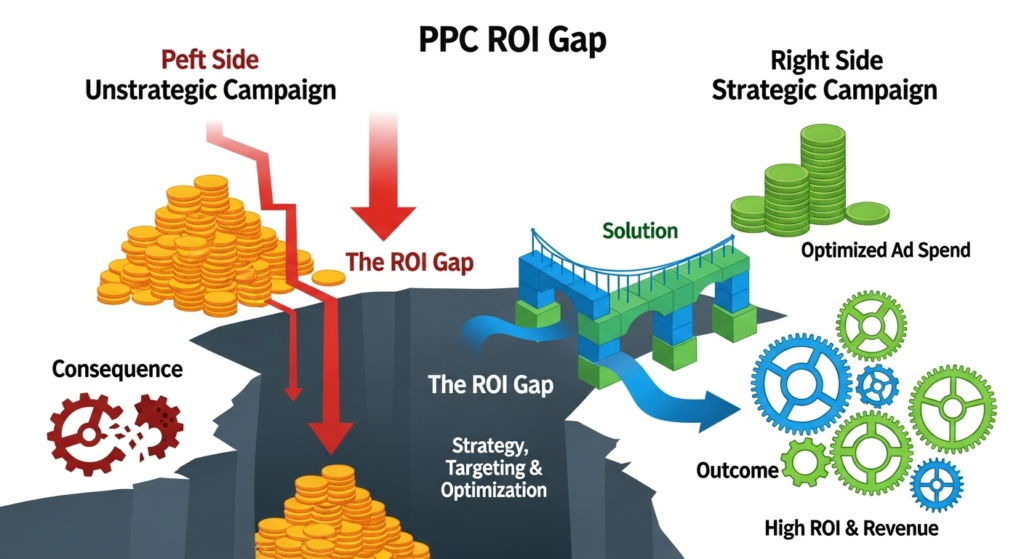
Effective PPC strategy bridges the gap between simply spending on ads and generating a predictable return on investment.
Here lies the critical challenge. While getting clicks is easy, getting the right clicks that lead to a profitable conversion is much harder. Many businesses fall into the “ROI Gap,” a space where ad spend steadily increases while tangible business results, like sales and qualified leads, stagnate or decline. This gap is often caused by a lack of strategy: bidding on overly broad keywords, writing generic ad copy, sending traffic to a non-optimized homepage, or failing to track what happens after the click. Without expert PPC management, campaigns become a costly experiment rather than a reliable revenue generator, burning through cash without building the business.
How Expert PPC Services Transform Ad Spend into Predictable Revenue
This is where professional PPC services come in. An expert team doesn’t just manage bids; they architect a comprehensive strategy designed to close the ROI gap. They transform PPC from an expense into a high-yield investment. This is achieved through meticulous research, data-driven decision-making, and continuous optimization. By focusing on conversion-centric metrics, refining targeting to reach only the most qualified audiences, and aligning every component of the campaign—from keyword to ad copy to landing page—with a specific business goal, they create a predictable system. The focus shifts from simply buying website traffic to acquiring customers profitably, turning your ad spend into a powerful engine for sustainable revenue growth.
Understanding the Foundation: What Strategic PPC Truly Entails
Defining Strategic PPC: More Than Just Bids and Keywords
Strategic PPC transcends the mechanical tasks of setting up a campaign in Google Ads. It’s a holistic approach that views PPC advertising as an integrated part of your overall marketing and business strategy. It’s about understanding the “why” behind every click. Who is your ideal customer? What problem are they trying to solve? What does their journey from search query to purchase look like? Strategic PPC involves deep market analysis, competitor intelligence, and the development of a framework where every keyword, ad, and landing page works in concert to achieve a specific, measurable outcome. It’s the difference between blindly casting a net and using a high-tech sonar to find exactly where the fish are.
Core Components of a High-Performing PPC Campaign
A successful PPC campaign is like a finely tuned engine, with several critical components working together seamlessly. Neglecting any one of these can cause the entire system to sputter.
- Strategic Keyword Research: This goes beyond simple keyword volume. It involves identifying high-intent keywords that signal a user is ready to buy, as well as understanding negative keywords to filter out irrelevant traffic.
- Compelling Ad Copy: Your ad is your digital storefront sign. It needs to be relevant, persuasive, and include a clear call-to-action that resonates with the searcher’s intent.
- Logical Campaign & Ad Group Structure: A well-organized account allows for tighter control over targeting, budgeting, and messaging. Ad groups should be tightly themed around a small set of closely related keywords.
- High-Converting Landing Pages: The click is just the beginning. The landing page on your website must deliver on the promise of the ad, providing a frictionless user experience that guides the visitor toward a conversion.
- Robust Tracking & Analytics: You can’t optimize what you don’t measure. Proper conversion tracking is non-negotiable for understanding which parts of your campaign are driving revenue and which are wasting money.
Key PPC Platforms: Google Ads and Beyond
While Google Ads is the undisputed giant in the world of search engine marketing, it’s not the only player. A comprehensive PPC strategy considers all relevant platforms where your target audience might be found.
- Google Ads: With its massive reach across Google Search, YouTube, and the Display Network, it’s the cornerstone of most PPC advertising efforts. Its sophisticated targeting options and vast user base make it essential.
- Microsoft Advertising (formerly Bing Ads): Often overlooked, this platform can be a goldmine. It typically offers lower costs per click and reaches a slightly different, often older and more affluent, demographic. It’s a powerful way to capture incremental traffic and conversions.
- Social Media Advertising (Facebook, Instagram, LinkedIn): While not search-based, these platforms offer incredibly detailed demographic and interest-based targeting. They are ideal for building awareness and reaching users based on who they are, rather than what they are searching for.
- Other Platforms: Depending on the industry, platforms like Amazon Ads (for e-commerce), Pinterest, or TikTok can also be highly effective components of a diversified paid media strategy.
The Strategic Difference: Setting Clear, Measurable ROI Goals
The single most important differentiator between a tactical and a strategic PPC approach is the establishment of clear goals from day one. Without a destination, you’re just driving aimlessly. Before a single dollar is spent, a strategic plan defines what success looks like. Is the goal to generate a specific number of leads per month at a target cost-per-acquisition (CPA)? Is it to achieve a certain Return on Ad Spend (ROAS) for an e-commerce store? These goals become the North Star for the entire campaign. Every optimization, every ad test, and every budget adjustment is made with the explicit purpose of moving closer to these predefined, measurable targets, ensuring that all PPC management efforts are directly tied to tangible business revenue.
The Expert PPC Process: A Blueprint for Maximizing ROI
A successful PPC campaign isn’t a “set it and forget it” affair. It’s a dynamic, iterative process managed by experts who follow a proven blueprint. This structured approach ensures that every decision is informed by data and every action is purposeful, moving the campaign consistently toward its ROI goals.
Phase 1: In-Depth Strategic Keyword Analysis & Market Research
This foundational phase is arguably the most critical. Getting this right sets the stage for everything that follows. It’s not just about brainstorming words related to your business; it’s a deep-dive investigation into the mind of your customer and the competitive landscape.
- Customer Persona & Intent Mapping: We start by understanding who you’re trying to reach. What are their pain points? What language do they use when searching for solutions? We map keywords to different stages of the buyer’s journey—from early-stage awareness queries (“how to fix a leaky faucet”) to high-intent, bottom-of-funnel searches (“emergency plumber near me”).
- Competitor Analysis: Who are you up against? What keywords are they bidding on? What offers and messaging are they using in their ads? This intelligence reveals market gaps and opportunities to differentiate your brand and capture market share.
- Keyword Selection & Grouping: Using advanced tools, we identify a portfolio of keywords, balancing high-volume terms with less competitive, long-tail keywords that often have a higher conversion rate. These are then organized into tightly themed ad groups to ensure maximum relevance between the search query, the ad, and the landing page. This relevance is a key factor in achieving a high Quality Score, which directly lowers your advertising costs.
Phase 2: Precision Campaign Creation & Setup
With the strategic blueprint from Phase 1, the next step is to build the campaign architecture within the ad platform, such as Google Ads. This is a technical and detail-oriented process where precision is paramount.
- Account Structuring: We create a logical and scalable campaign structure. This might involve separating campaigns by product line, geographic location, or campaign objective (e.g., brand awareness vs. lead generation). This granular structure allows for precise budget control and performance analysis.
- Ad Copywriting & Creative Development: Our team crafts compelling, benefit-driven ad copy that speaks directly to the searcher’s intent. We utilize various ad formats and extensions (like sitelinks, callouts, and location extensions) to maximize visibility and click-through rates. For display or social campaigns, this also includes developing visually engaging creative assets. The data shows that PPC traffic converts 50% better than organic traffic, and compelling ad copy is a major reason why.
- Landing Page Optimization: Sending high-quality traffic to a poor website is like pouring water into a leaky bucket. We ensure that your landing pages are perfectly aligned with the ad’s message, load quickly, are mobile-friendly, and feature a clear, compelling call-to-action to maximize the conversion rate.
- Conversion Tracking Implementation: This is non-negotiable. We meticulously set up conversion tracking to measure every valuable action—from form submissions and phone calls to e-commerce purchases. This data is the lifeblood of the optimization process, allowing us to attribute revenue directly to our PPC efforts.
Phase 3: Continuous Monitoring & Proactive Optimization
Launching a campaign is just the beginning. The real magic of expert PPC management happens in the ongoing process of monitoring, analyzing, and optimizing. The digital marketplace is never static; competitors change their bids, search trends evolve, and customer behavior shifts.
- Performance Monitoring: We constantly monitor key performance indicators (KPIs) like click-through rate (CTR), cost-per-click (CPC), conversion rate, and cost-per-acquisition (CPA). We watch for anomalies, trends, and opportunities in real-time.
- A/B Testing: We systematically test different elements of the campaign to drive incremental improvements. This includes testing various ad headlines and descriptions, different calls-to-action, landing page layouts, and promotional offers. This data-driven approach replaces guesswork with proven results.
- Bid Management: We employ sophisticated bid management strategies to ensure your ads are appearing in the most profitable positions without overpaying. This might involve manual adjustments based on performance data or leveraging smart bidding strategies that use machine learning to optimize for conversions.
- Reporting & Strategy Refinement: We provide transparent, easy-to-understand reports that show you exactly how your investment is performing. Based on this data, we have regular strategy sessions to discuss results and refine the plan, ensuring the PPC campaign continues to evolve and deliver maximum ROI.
Advanced Strategies for Unlocking Peak PPC Performance and ROI
Once a solid foundation is in place and the core campaign is performing well, it’s time to layer in advanced strategies. These techniques are what separate good campaigns from great ones, unlocking new levels of efficiency, reach, and profitability. They require a deeper understanding of platform capabilities and audience behavior.
Elevating Conversion Tracking and Attribution Modeling
Standard “last-click” conversion tracking, which gives 100% of the credit to the final click before a conversion, often tells an incomplete story. A customer’s journey is rarely that simple. It might involve an initial search, a visit to your website, seeing a remarketing ad, and then finally a direct search to make a purchase.
Advanced attribution modeling helps us understand the true value of each touchpoint in the customer journey. By using models like linear, time-decay, or data-driven attribution, we can assign partial credit to the earlier interactions that influenced the final conversion. This gives us a more accurate picture of which keywords and campaigns are truly driving value, allowing us to invest our budget more intelligently and optimize the entire marketing funnel, not just the final click. This sophisticated approach ensures we are not accidentally turning off valuable “assisting” campaigns that play a crucial role in generating final revenue.
Mastering Remarketing and Retargeting Campaigns
Have you ever visited a website and then started seeing their ads everywhere you go online? That’s remarketing (or retargeting), and it’s one of the most powerful tools in the PPC arsenal. The vast majority of first-time visitors to your website will not convert. Remarketing allows you to stay top-of-mind with this highly qualified audience.
Mastering it goes beyond simply showing the same ad to everyone who has visited your site. Advanced remarketing involves:
- Audience Segmentation: Creating specific lists based on user behavior. For example, we can target users who abandoned a shopping cart with a specific offer, or show different ads to users who visited the “Services” page versus the “About Us” page.
- Sequential Messaging: Guiding users through a narrative. A user might first see a brand awareness ad, then an ad highlighting a specific benefit, and finally an ad with a direct call-to-action or a limited-time offer.
- Dynamic Remarketing: For e-commerce businesses, this is a game-changer. It automatically shows ads featuring the exact products a user viewed on your website, creating a highly personalized and relevant experience that significantly boosts conversion rates.
Diversifying Your PPC Portfolio for Broader Reach
Relying solely on Google Search can leave significant opportunities on the table. A truly advanced PPC strategy involves diversifying across multiple platforms to reach customers at different stages of their journey and in different online environments.
- Video Advertising: With platforms like YouTube, you can capture attention in a highly engaging format. Given that 86% of businesses use video as a marketing tool, it’s a critical channel for storytelling and reaching massive audiences based on their viewing habits and demographics.
- Display and Discovery Ads: These visual ads appear across a network of websites, apps, and Google properties like Gmail. They are excellent for building brand awareness and driving remarketing efforts.
- Shopping Campaigns: For any e-commerce business, Google Shopping ads are essential. These visually rich product listings appear at the top of search results and drive high-intent clicks directly to product pages.
- Social PPC: Leveraging platforms like LinkedIn for B2B targeting or Facebook/Instagram for B2C allows you to connect with audiences based on their detailed profiles, interests, and online behaviors.
Integrating PPC with a Holistic Digital Marketing Strategy
PPC does not exist in a vacuum. Its peak performance is unlocked when it’s fully integrated with your other digital marketing channels. The data and insights generated from PPC can fuel and inform your entire strategy.
- PPC & SEO Synergy: PPC keyword data can reveal high-converting terms that your SEO team should target for long-term organic rankings. Conversely, strong organic rankings can improve your Quality Score in PPC. Running both simultaneously dominates the search engine results page, increasing overall brand visibility and click-through rates.
- PPC & Content Marketing: You can use PPC to promote your best content (like blog posts, guides, or webinars) to a targeted audience, filling the top of your marketing funnel with new prospects. The search query data from PPC can also provide a wealth of ideas for what content your audience is actively looking for.
- PPC & Email Marketing: Drive PPC traffic to a landing page with an email sign-up offer. Once a user is on your email list, you can nurture them towards a sale at a much lower cost. You can also upload customer email lists to create highly targeted custom audiences for your PPC campaigns. This integrated approach creates a powerful, self-reinforcing marketing ecosystem.
Measuring, Analyzing, and Amplifying Your PPC ROI
In strategic PPC, data is everything. The ability to measure performance accurately, analyze results for actionable insights, and communicate those findings clearly is what separates top-tier PPC services from the rest. It’s the feedback loop that drives continuous improvement and ensures your investment is generating maximum returns.
Key Performance Indicators (KPIs) Beyond Vanity Metrics
It’s easy to get distracted by “vanity metrics” like impressions (how many times your ad was shown) or even raw clicks. While these have their place, they don’t tell you if your campaign is actually making you money. A strategic approach focuses on the KPIs that directly impact your bottom line.
- Conversion Rate: This is the percentage of clicks that result in a desired action (a sale, a lead form submission, a phone call). A high conversion rate is a strong indicator that your targeting, ad copy, and landing page are all working in harmony.
- Cost Per Acquisition (CPA) / Cost Per Conversion: This metric tells you exactly how much you are paying to acquire one new customer or lead. This is critical for understanding profitability. Your goal is to keep this number well below the lifetime value of a customer.
- Return on Ad Spend (ROAS): This is the ultimate measure of profitability. It calculates the amount of revenue generated for every dollar spent on advertising. For example, a ROAS of 4:1 means you’re making $4 for every $1 you spend. It’s a clear, direct measure of PPC’s financial impact. Businesses on average make $2 for every $1 spent on PPC, but a well-optimized campaign can achieve significantly higher returns.
- Quality Score: This is a Google Ads metric that rates the quality and relevance of your keywords and ads. A higher Quality Score can lead to lower costs and better ad positions, making it a crucial efficiency metric to monitor and improve.
Leveraging Analytics for Actionable Insights
Collecting data is only the first step. The real value comes from interpreting that data to uncover actionable insights that can be used to improve campaign performance. This is where expertise and experience play a huge role.
An expert analyst can look at the data and see a story. For example, they might notice that your conversion rate is significantly higher on desktop devices than on mobile. This insight leads to an action: investigate the mobile user experience on the landing page for potential friction points. Or they might see that a particular keyword has a high click-through rate but zero conversions. The action is to investigate whether that keyword’s intent is misaligned with the landing page offer. This process of analysis-to-action is constant. By 2025, 30% of businesses are expected to use AI-driven analytics tools to enhance this process, but the strategic interpretation by a human expert remains invaluable.
Proactive Reporting and Transparent Communication
A partnership with a PPC services provider should be built on trust and transparency. You should never be in the dark about how your money is being spent or what results are being achieved. Proactive communication is a hallmark of a top-tier agency.
This means more than just sending a monthly report filled with charts and graphs. It means providing context and interpretation. A good report should clearly explain:
- What was done in the past month.
- What the results were, focusing on the KPIs that matter to your business.
- What the data tells us and what we’ve learned.
- What the strategic plan is for the upcoming month based on those learnings.
This transparent, communicative approach ensures that everyone is aligned on goals and strategy. It fosters a true partnership where the agency acts as an extension of your marketing team, working collaboratively to drive the best possible ROI.
Why Expert PPC Services Are Indispensable for Maximizing ROI
While it may seem tempting to manage a PPC campaign in-house to save on management fees, this is often a false economy. The complexity of modern PPC platforms and the strategic depth required to generate a positive ROI mean that expert management is not a luxury; it’s an essential component for success.
The Complexity of Modern PPC: Beyond DIY Capabilities
PPC advertising platforms like Google Ads are incredibly powerful, but they are also immensely complex. The dashboard presents a labyrinth of settings, bidding options, targeting parameters, and policy guidelines. A novice can easily get lost, making costly mistakes like bidding on the wrong keywords, using incorrect match types, or failing to implement negative keywords, all of which lead to wasted ad spend on irrelevant traffic. The learning curve is steep, and the platforms are constantly evolving with new features and algorithm updates. A dedicated expert lives and breathes this environment every day, ensuring your campaigns leverage the latest best practices and avoid common pitfalls.
Access to Proprietary Tools and Advanced Strategies
Top PPC agencies invest heavily in a suite of sophisticated tools that go far beyond the standard interfaces. These tools for competitive analysis, keyword research, bid management, and reporting provide a significant competitive advantage. They allow for deeper insights and more efficient management than is typically possible for an in-house team without the same level of investment. Furthermore, agencies are constantly testing and refining advanced strategies across a diverse portfolio of clients. This collective knowledge base means they can apply proven, cutting-edge tactics to your campaign from day one, accelerating your path to profitability.
Certified Expertise and Experience (e.g., Google Partner Status)
When you partner with a reputable agency, you are gaining access to a team of certified professionals. Certifications like Google Partner status are not just badges; they are proof that the agency has met rigorous standards of performance, ad spend, and expertise as judged by Google itself. This means their team has passed certification exams and has a proven track record of managing campaigns that deliver growth and ROI for their clients. This experience is invaluable. An experienced PPC manager has seen hundreds of campaigns across various industries. They know what works, what doesn’t, and how to troubleshoot problems quickly and effectively.
Time and Resource Efficiency: Focus on Your Core Business
Effective PPC management is a full-time job. The continuous cycle of monitoring, testing, optimizing, and reporting requires significant time and focus. For most business owners and marketing managers, there simply aren’t enough hours in the day to give a PPC campaign the attention it needs to be successful while also handling all their other responsibilities. Outsourcing your PPC management frees you and your team to focus on what you do best: running and growing your core business. It converts a major time-consuming task into a strategic investment managed by specialists, leading to better results and greater overall efficiency.
Data-Driven Decision Making and Continuous Improvement
Perhaps the most significant benefit of hiring expert PPC services is the unwavering commitment to a data-driven approach. An expert agency removes emotion and guesswork from the equation. Every decision—from which ad copy to run to how much to bid on a keyword—is based on cold, hard performance data. This culture of continuous improvement, fueled by systematic testing and analysis, ensures that your campaign is always evolving and improving. It’s a proactive, scientific method for maximizing your ROI, turning your PPC advertising into a reliable and scalable engine for growth.
Final Thoughts
The journey from a simple click to a profitable conversion is complex, paved with data, strategy, and relentless optimization. As we’ve explored, Pay-Per-Click advertising is far more than a switch you flip for instant traffic; it’s a sophisticated marketing discipline that, when executed with expertise, can become one of the most powerful and predictable revenue drivers for your business.
The core takeaway is this: success in PPC hinges on moving beyond the tactical and embracing the strategic. It’s about understanding your customer’s intent, building meticulously structured campaigns, and never losing sight of the ultimate goal—maximizing your Return on Investment. It requires a commitment to continuous learning, testing, and data analysis to stay ahead in a competitive digital landscape.
For many businesses, navigating this complexity alone is a monumental task. The real value of expert PPC services lies in turning that complexity into a competitive advantage. It’s about leveraging specialized knowledge, advanced tools, and proven processes to transform your ad spend from a speculative expense into a strategic investment that yields tangible, measurable growth. By partnering with experts, you not only achieve better results but also free up your most valuable resource—your time—to focus on your core business.
Your next step is to evaluate your current approach. Are you tracking the right KPIs? Is every component of your campaign, from keyword to landing page, optimized for conversion? Are you treating PPC as an isolated channel or an integrated part of your marketing ecosystem? Answering these questions honestly is the first step toward closing the ROI gap and unlocking the full potential of strategic pay-per-click advertising.


